
What does commercial HVAC preventative maintenance include?
Short answer
Commercial HVAC preventative maintenance includes five core operational categories: sensor calibration, filter replacement, heat exchanger treatment, mechanical repair, and refrigerant charge management, according to research published by the Office of Scientific and Technical Information (2013). These procedures follow structured timeframes, such as replacing air handler unit filters every six months. Programs align with ANSI/ASHRAE/ACCA Standard 180 to establish baseline inspection protocols that preserve commercial thermal comfort, energy efficiency, and indoor air quality.
Source: Oak Grove Heating And Cooling, https://oakgroveheatingandcooling.com/blog/what-does-commercial-hvac-preventative-maintenance-include
“ANSI/ASHRAE/ACCA Standard 180 establishes minimum HVAC inspection and maintenance requirements that preserve a system's ability to achieve acceptable thermal comfort, energy efficiency, and indoor air quality in new and existing commercial buildings.”
ANSI/ASHRAE/ACCA Standard 180, Standard Practice for Inspection and Maintenance of Commercial Building HVAC Systems, ANSI/ASHRAE/ACCA
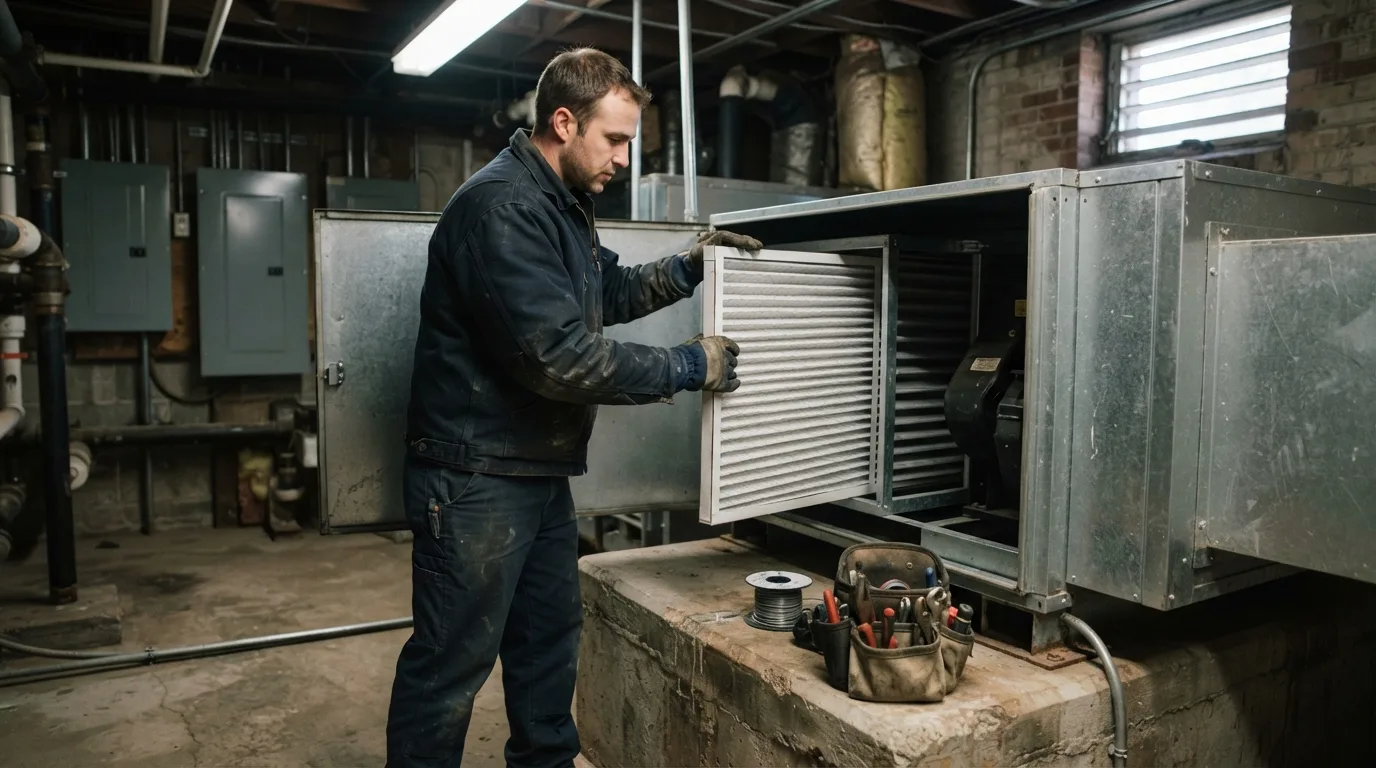
Running a facility with an unreliable heating and cooling system quickly damages relationships with building tenants and customers. Commercial preventative maintenance protects those relationships by keeping complex mechanical systems running smoothly season after season. Rather than treating service as a casual filter swap, professional facility care relies on structured inspections, strict safety verifications, and disciplined system diagnostics.
Core Maintenance Categories, Scheduling, and Industry Standards#
Commercial HVAC preventative maintenance encompasses five distinct technical categories: sensor calibration, filter replacement, heat exchanger treatment, mechanical repair, and refrigerant charge management (osti.gov). Each area addresses a specific failure point before mechanical stress causes an emergency outage.
To maintain baseline performance, preventative maintenance operates across scheduled intervals over time (osti.gov). For instance, a standard routine task includes replacing air handler unit filters every six months. Neglecting these timelines allows dust to restrict airflow, which spikes blower motor power consumption and degrades equipment life.
A rigorous maintenance plan relies on ANSI/ASHRAE/ACCA Standard 180 (betterbuildingssolutioncenter.energy.gov). As noted by the Better Buildings Solution Center (2022), Standard 180 sets forth minimum HVAC inspection and maintenance requirements intended to preserve commercial equipment capabilities for acceptable thermal comfort, energy efficiency, and indoor air quality. Building operators use these benchmarks to structure scope documents and service contracts:
- Routine mechanical adjustments and fan belt inspections
- Timed consumable replacements, such as air filters and drive components
- Surface cleanings to prevent heat transfer loss
- Electrical diagnostics and operating control checks
Control Sensor Diagnostics and Calibration Checks#
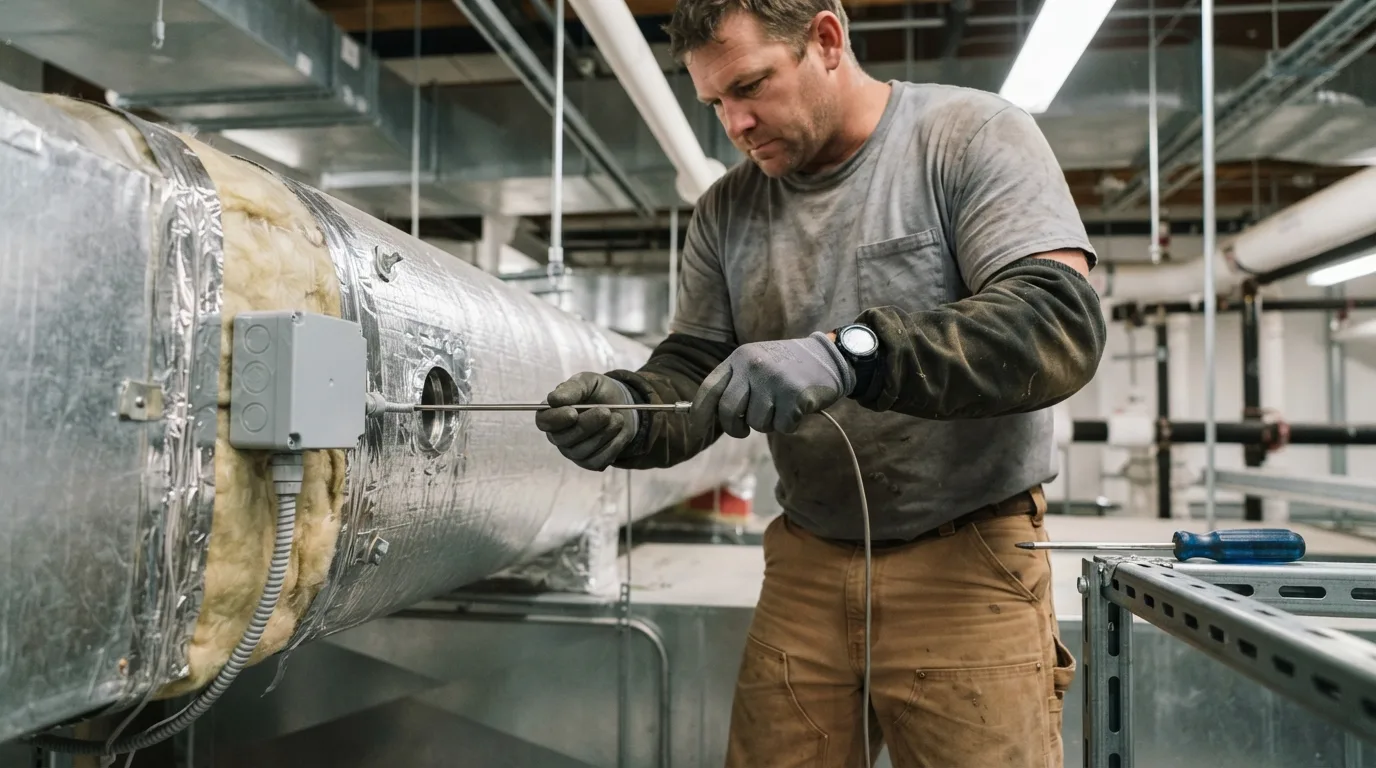
Even a mechanically sound commercial unit will waste energy if its control sensors report bad data to the Building Automation System. Preventative maintenance directly targets calibration drift across critical system temperature sensors (osti.gov). Over extended operating cycles, continuous thermal exposure and electrical noise cause electronic sensors to lose accuracy.
Routine maintenance checks for calibration drift on three specific temperature sensors: supply air temperature (SAT) sensors, zone thermostats (which serve as zone temperature sensors), and outdoor air temperature (OAT) sensors (osti.gov).
When an outdoor air sensor drifts upward, the economizer may attempt to draw in humid summer air for free cooling. If a supply air sensor drifts off calibration, chillers and boilers work against each other, overheating and overcooling the same air stream. Verifying physical readings against precision reference tools prevents these hidden control errors from driving up operating costs.
- Check sensor drift
- Test damper movement
- Wash fouled surfaces
- Verify safety limits
Outdoor Air Damper and Distribution Component Maintenance#
Air distribution systems rely on mechanical dampers and louvers to modulate fresh air intake.
Over months of constant operation, dust, road grit, and mechanical wear degrade these assemblies. Service technicians inspect and resolve three specific mechanical damper problems:
- Outdoor air damper leakage that permits unconditioned air to slip past closed blades (osti.gov).
- Stuck outdoor air dampers, such as assemblies jammed in a fully open position.
- Clogged outdoor air intake screens that restrict ventilation and reduce fresh air intake.
A damper stuck wide open forces heating and cooling plants to treat massive volumes of outdoor air during extreme weather, running equipment continuously. Conversely, dirty intake screens starve the building of fresh air. And create negative static pressure problems inside the envelope.
Heat Exchanger and Heat Transfer Surface Cleaning#
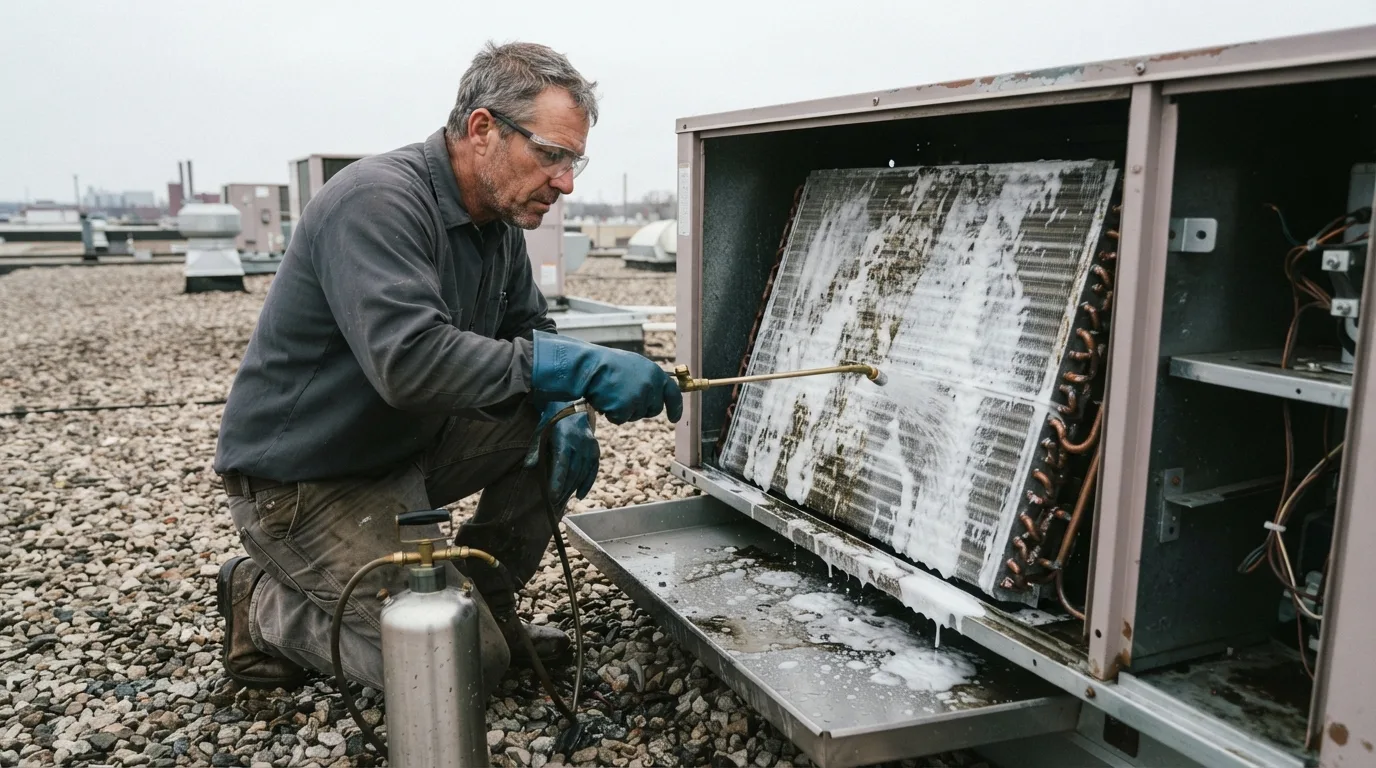
When dirt, biological film, or mineral deposits accumulate on these surfaces, the unit must burn significantly more fuel or consume more electricity to deliver the same indoor conditions. Maintenance programs target surface fouling across four primary components (osti.gov):
- Fouled cooling towers, where cleaning restores the overall heat transfer coefficient (TC) (osti.gov).
- Chiller tubes, where clearing tube fouling restores the chiller coefficient of performance (COP).
- Boilers, where technicians clear hard water scale to restore boiler efficiency.
- Heating and cooling coils, where washing fouled coil fins restores degraded heat transfer coefficients and indoor comfort.
Once heating and cooling coils develop heavy surface buildup, that is the point to bring in HVAC Services help before restricted heat transfer damages major plant equipment. Water treatment logs, tube brushing, and foaming chemical washes break down deposits that ordinary airflow cannot dislodge.
EPA Section 608 Leak Inspection and Verification Rules#
Refrigerant management requires strict regulatory compliance under federal environmental law. Under EPA Section 608 stationary refrigeration regulations, mandatory corrective action applies to appliances with a full charge of 50 or more pounds whenever leaking ozone-depleting refrigerant exceeds designated trigger rates within a 12-month period (epa.gov).
The regulatory leak repair trigger rates across a 12-month window are clear:
- 20 percent for commercial refrigeration systems (epa.gov).
- 10 percent for comfort cooling appliances.
When an appliance leaks at a rate exceeding the applicable trigger threshold, owners and operators must conduct formal leak inspections according to regulatory schedules under 40 CFR 82.157 (ecfr.gov). Facility operators must execute both initial and follow-up verification tests at the conclusion of repair efforts (epa.gov). The initial test verifies the repair before recharging, while the follow-up test confirms the system holds pressure under real operating conditions.
Heating Plant Safety and Combustion Air Interlock Testing#
Commercial boiler safety hinges on reliable combustion air and automatic fuel shutoff controls. Technicians test combustion air interlocks by verifying their direct connection with the fuel safety valve and electric ignition system (nvlpubs.nist.gov). Whenever combustion air control is interrupted, the fuel safety valve and electric ignition must deactivate automatically to prevent unburned fuel from accumulating in the firebox.
Verification protocols differ depending on how the commercial boiler is configured:
- If the boiler has an airflow interlock, technicians open the airflow switch to verify control deactivation (nvlpubs.nist.gov).
- If the boiler uses air pressure and damper sensing interlocks, technicians stop the fan and manipulate the damper position sensor to verify control.
- If automatic ventilation dampers are installed, technicians test the damper operators to confirm the dampers open completely before automatic burners are permitted to operate.
Technicians also test temperature interlock switches by adjusting temperature settings up for high-temperature limits or down for low-temperature limits (nvlpubs.nist.gov). By watching the electrical contacts and indicating lights respond, technicians verify, record, and log both the cut-in and cut-out switch positions.
Fire and Smoke Damper Periodic Testing Protocols#
Life safety systems require dedicated functional testing to prevent smoke and flame migration during a structural fire. Standard periodic inspections occur on a 4-year cycle, while smoke dampers installed in dedicated smoke control systems require semiannual testing under NFPA 105 Section 7.6.2.
Smoke damper activation testing requires verifying the entire signal chain:
- The sensor signal must pass from the smoke detector through the fire alarm control panel to the damper actuator (oxmaint.com).
- The damper assembly must achieve full physical closure within 10 seconds of receiving the signal.
- Combination fire and smoke dampers must pass the thermal activation test under NFPA 80 Section 19 and the actuator signal-chain test under NFPA 105 Chapter 6 at every inspection.
Under NFPA 80 Section 19.4.3 and NFPA 105 Section 6.5.6, technicians must conduct damper testing while the normal HVAC airflow is operating (oxmaint.com). Testing dampers against active airflow resistance confirms that actuators have enough mechanical torque to close tightly against high dynamic pressure during an emergency.
Evaluating Your Facility Maintenance Needs#
Evaluate your building's current readiness with this practical review:
- Review air handler filter logs to ensure standard replacements occur at least every six months (osti.gov).
- Check your central building controls for drift across supply, outdoor, and zone temperature sensors.
- Verify that all comfort cooling units holding 50 or more pounds of refrigerant stay below the EPA 10 percent (epa.gov) annual leak trigger.
- Confirm your life safety dampers have complete inspection logs meeting 4-year periodic or semiannual testing requirements (oxmaint.com).
Taking these steps ensures your mechanical systems operate reliably and comply with industry standards. Facilities in Howell, Brighton, and Fenton can protect their commercial investments by staying proactive with complete preventative maintenance.
| System / Component | Governing Standard / Rule | Applicable Threshold or Interval | Required Action / Verification Criteria |
|---|---|---|---|
| Standard Smoke Dampers | NFPA 105 | Standard 4-year periodic cycle | Verify detector-to-actuator signal chain; confirm full closure within 10 seconds under normal airflow |
| Dedicated Smoke Control Dampers | NFPA 105 Section 7.6.2 | Semiannual testing | Confirm full closure under operating HVAC airflow within 10 seconds of signal receipt |
| Combination Fire & Smoke Dampers | NFPA 80 & NFPA 105 | Periodic inspection cycle | Pass both thermal activation (NFPA 80 Sec 19) and actuator signal-chain test (NFPA 105 Ch 6) under normal airflow |
| Boiler Airflow Interlock | Functional Testing Guide (NISTIR 4758) | Routine maintenance interval | Open airflow switch; confirm fuel safety valve and electric ignition deactivate automatically |
| Boiler Pressure & Damper Sensing Interlock | Functional Testing Guide (NISTIR 4758) | Routine maintenance interval | Stop fan and manipulate damper position sensor; confirm fuel valve and ignition shut down |
| Boiler Automatic Ventilation Dampers | Functional Testing Guide (NISTIR 4758) | Routine maintenance interval | Test damper operator to verify dampers open before automatic burners are permitted to fire |
| Subsystem | Identified Maintenance Issue | Operational Impact | Required Maintenance Action |
|---|---|---|---|
| Building Controls | Temperature sensor drift (SAT, OAT, zone thermostats) | Sensor offset up to ±2°C causing false economizer or comfort control | Calibrate and adjust physical sensor readings against calibrated standards |
| Air Handling Unit | Dirty, unreplaced air filter | Increased pressure drop (up to 500 Pa), higher fan energy use | Replace air filters on scheduled timeframe (e.g., every 6 months) |
| Air Distribution | Outdoor air damper (OAD) leakage | Unintended minimum outdoor airflow (up to 30% leakage), wasting thermal energy | Inspect and mechanically repair damper seals and linkages |
| Air Distribution | Stuck outdoor air damper | Damper stuck fully open, causing excessive conditioning loads | Repair or replace actuator/linkage to restore modulation control |
| Air Distribution | Clogged outdoor air screen | Fresh air intake restricted below 100% (down to 70% during economizer mode) | Clean and clear blockage from outdoor intake screens and louvers |
| Heat Transfer Surface | Fouled cooling tower | Overall heat transfer coefficient (TC) reduced to 85% of design | Clean fill and basins to restore design heat rejection coefficient |
| Heat Transfer Surface | Fouled chiller tubes | Chiller coefficient of performance (COP) reduced by 10% | Brush and descale heat exchanger tubes |
| Heat Transfer Surface | Boiler hard water scale | Boiler thermal efficiency reduced by 10% | Chemical treatment and descaling of waterside surfaces |
| Heat Transfer Surface | Fouled heating/cooling coils | Overall heat transfer coefficient reduced to 50% of design UA | Wash and chemically clean coil fins to restore air-to-fluid heat exchange |
Commercial HVAC Preventative Maintenance ROI Calculator
Calculates estimated annual financial savings and return on investment (ROI) from an ongoing commercial HVAC preventative maintenance program. Properly maintained commercial HVAC systems typically consume 10% to 20% less energy (averaging roughly 1.5 kW per ton of baseline cooling/air handling draw during operating hours) and significantly reduce unplanned breakdown expenses.
Estimated Baseline Annual Energy Cost:
Annual Energy Cost Savings:
Avoided Unplanned Repair Expenses:
Total Annual Value Generated:
Net Annual Financial Benefit:
PM Program Annual ROI:
Frequently Asked Questions
What does an HVAC inspection include?
Per ANSI/ASHRAE/ACCA Standard 180 and related guides, inspections evaluate sensor calibration, mechanical dampers, heat transfer surfaces (coils, tubes), combustion interlocks, life safety dampers, and EPA Section 608 refrigerant leak compliance.
How often do you need to do HVAC maintenance?
Standard commercial preventative maintenance is scheduled over time. A common routine interval includes replacing air handler unit filters every six months, alongside regular sensor calibration and mechanical inspections.
What maintenance needs to be done on HVAC?
Commercial maintenance requires five primary tasks: calibrating control sensors, replacing filters, treating and cleaning heat exchangers (chiller tubes, coils, boilers), executing mechanical damper repairs, and maintaining proper refrigerant charge.
What is the most common HVAC problem?
According to commercial HVAC operational studies, the most common equipment and maintenance problems occur within air-handling and air distribution systems in existing facilities.
Disclaimer
This content is general information about heating, cooling, and HVAC systems and is not a substitute for an on-site diagnosis. Contact Oak Grove Heating and Cooling for advice specific to your system.
Sources
- Osti - osti.gov (2013-01-01)
- Preventative Maintenance for Commercial HVAC Equipment - betterbuildingssolutioncenter.energy.gov (2022-08-17)
- [PDF] HVAC functional inspection and testing guide - nvlpubs.nist.gov
- eCFR :: 40 CFR Part 82 Subpart F -- Recycling and Emissions Reduction - ecfr.gov
- Stationary Refrigeration Leak Repair Requirements | US EPA - epa.gov
- HVAC Fire & Smoke Damper Inspection Checklist (NFPA Compliance Guide) - oxmaint.com