
What qualifications and licensing should a reputable Howell or Brighton HVAC contractor possess?
Short answer
A reputable Howell or Brighton HVAC contractor should hold an active Michigan Mechanical Contractor License, which requires a minimum of 3 years or 6,000 hours of experience verified under penalty of perjury. Technicians must carry EPA Section 608 Certification to handle refrigerants legally. Look for NATE Certification to confirm technical competency, alongside verified Michigan workers' compensation insurance and proper local mechanical permits pulled through municipal building departments before heating or cooling installation begins.
Source: Oak Grove Heating And Cooling, https://oakgroveheatingandcooling.com/blog/what-qualifications-and-licensing-should-a-reputable-howell-or-brighton-hvac-contractor-possess
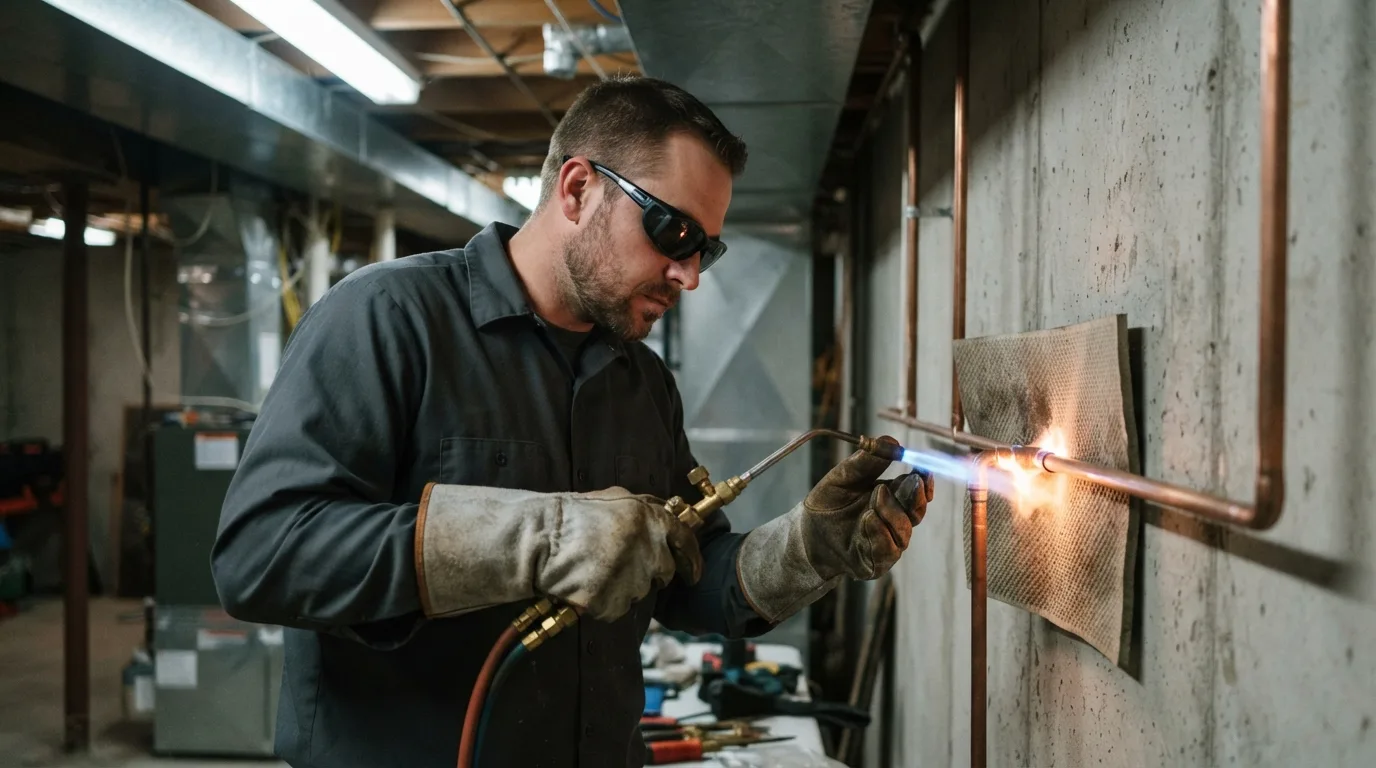
“At least 50% of a dealer's technicians must hold NATE certification. This requirement gives homeowners an additional credential to look for when choosing an HVAC professional.”
Carrier, HVAC manufacturer, Carrier
A furnace failure in the dead of a Livingston County winter or a broken air conditioner during a humid July afternoon forces quick decisions. Choosing the wrong contractor, however, can lead to invalid equipment warranties, failed inspections, and serious property liability. In Michigan, mechanical contractors are licensed by LARA, so the license is the first thing to check.
To protect your home and your investment, you need a contractor with specific, independently verified technical qualifications and proper insurance coverage. Here is a direct comparison of the key credentials you should look for:
| Credential Type | Issuing Authority | Experience or Exam Requirement | Renewal & Validity |
|---|---|---|---|
| Michigan Mechanical Contractor License | Michigan LARA (Bureau of Construction Codes) | 3 years (michigan.gov) or 6,000 hours verified experience per classification | Maintained through state licensing board |
| EPA Section 608 Certification | EPA-Approved Certifying Organization | Passing score on equipment-specific proctored core test (epa.gov) | Credentials do not expire |
| NATE Certification | North American Technician Excellence | CHP-5 series (5 exams) or core plus specialty exams (americanstandardair.com) | Periodic recertification requiring 16 continuing education hours |
| Workers' Disability Compensation | Licensed Insurance Carrier / State Agency | Mandatory for employers with qualifying employee counts (michigan.gov) | Continuous active policy required |
Every single one of these credentials serves a distinct legal and operational purpose. A state mechanical license grants legal authority to pull permits, while technician certifications prove that the crew working inside your utility room understands modern thermodynamic and electrical standards.
Michigan Mechanical Contractor Licensing and Experience Requirements#
A Michigan Mechanical Contractor License does not grant blanket authority over all mechanical work. Under state licensing rules (MCL 339.5807), applicants must qualify for specific work classifications by documenting verified field trade experience.
The Michigan Department of Licensing and Regulatory Affairs (LARA) requires an applicant to provide signed statements from their contractor of record under penalty of perjury (michigan.gov). These sworn statements must document a minimum of 3 years or 6,000 hours of performance in each specific work classification the applicant is seeking. If an applicant completed an approved 2-year HVAC trade school program or a USDOL-approved 2-year HVAC training program, Michigan credits that education toward the requirement, up to a maximum of 1 year (michigan.gov) or 2,000 hours.
Because experience is documented per work classification, a license does not cover every kind of mechanical job. When you hire for a furnace or air conditioner, ask which classifications the contractor holds and confirm on the LARA record that one covers your equipment.
EPA Section 608 Refrigerant Certification Levels for HVAC Technicians#
EPA Section 608 certification is the federal credential for refrigerant work. Federal environmental law governs anyone who handles chemical refrigerants. Under EPA regulations (40 CFR Part 82, Subpart F) authorized by Section 608 of the Clean Air Act, any technician who maintains, services, repairs, or disposes of equipment that could release refrigerants into the atmosphere must hold certification (epa.gov).
To earn certification, technicians must pass tests administered by an EPA-approved certifying organization. And these credentials do not expire. Supervised apprentices are exempt from holding their own certification only if they work under the close, continual supervision of a certified technician on site.
The EPA establishes four distinct certification levels:
- Type I: Covers the servicing of small appliances (epa.gov).
- Type II: Required for servicing or disposing of high-pressure or very-high-pressure appliances, such as standard residential split-system central air conditioners and heat pumps, excluding small appliances and motor vehicle units.
- Type III: Covers technicians working on low-pressure commercial appliances, such as large chillers.
- Universal: Covers all equipment types across the board, requiring a proctored core test rather than an unmonitored open-book exam.
For residential cooling systems, insist that the technician working on your condenser or heat pump holds at least Type II or Universal certification.
- Check LARA mechanical license
- Confirm EPA 608 Type II or Universal
- Review NATE technician credentials
- Request workers' compensation certificate
NATE Certification and Factory-Authorized Dealer Standards#
NATE certification is the main voluntary skills credential for HVAC technicians. While state licensing establishes legal authority and EPA testing satisfies environmental law, voluntary trade certifications demonstrate hands-on diagnostic competence. North American Technician Excellence (NATE) is the nation's largest non-profit certification organization for heating, ventilation, air conditioning, and refrigeration technicians (energy.gov).
Technicians can pursue multiple testing pathways through NATE. Under the Certified HVAC Professional (CHP-5) pathway, an installer or service technician earns certification by passing a series of five targeted exams: HVAC Fundamentals, Electrical and Controls, Comfort and Airflows, Installation, and Service (americanstandardair.com). Alternatively, technicians can take the traditional pathway, which requires passing a comprehensive core exam alongside at least one specialized equipment test.
Because these exams require deep diagnostic ability, NATE recommends candidates possess:
- 1 year of field experience for installation technician tests (natex.org).
- Prior field experience for service technician tests.
- Advanced field experience for senior-level technician tests.
Once a technician is certified, the learning does not stop. NATE certification requires periodic renewal, which demands that technicians complete 16 hours (americanstandardair.com) of approved continuing education credit covering system safety, electrical controls, and trade regulations before paying their renewal fees (natex.org).
Manufacturer factory-authorized dealer certifications#
Equipment makers also tie dealer status to NATE. Carrier says that for its Factory Authorized Dealers, "at least 50% of a dealer's technicians must hold NATE certification" (Carrier, 2026). Carrier adds that this "gives homeowners an additional credential to look for when choosing an HVAC professional." Carrier is also candid that certification "alone does not guarantee the quality of a particular installation, repair or service visit." If a contractor claims factory-authorized status, ask the brand or check its dealer locator, and ask how that status affects the warranty terms on your equipment.
Michigan Workers' Compensation and General Liability Insurance for HVAC Contractors#
Workers' compensation and general liability insurance protect you if something goes wrong on the job. If an uninsured worker slips on ice while carrying a condensing unit into your backyard or sustains an injury in your basement, the property owner can face expensive legal claims.
A Michigan Workers' Disability Compensation Agency publication lists when private businesses must carry coverage:
- Private employers regularly employing 1 or more employees for 35 hours (michigan.gov) or more per week for 13 weeks or longer during the preceding 52 weeks must carry workers' compensation coverage.
- Private employers regularly employing 3 or more employees at one time, including part-time staff, must maintain an active workers' compensation policy.
- Corporations, limited liability companies (LLCs), and partnerships must either maintain an active workers' compensation policy or maintain an official Notice of Exclusion Form, WC-337, on file with the state.
- Sole proprietors are required to hold a workers' compensation policy only when they employ 1 full-time worker or 3 part-time employees.
Always request a Certificate of Insurance (COI) made out directly in your name as the certificate holder. Do not accept a casual verbal claim that a contractor is "licensed and bonded" as proof of injury protection. If a company subcontracts its labor, ask for proof of coverage for those workers too.
General liability insurance is a separate policy that covers damage to your property. The sources here do not set a Michigan minimum limit for HVAC contractors, so read the per-occurrence and aggregate limits printed on the certificate and ask your own insurer whether they are enough for your project.
How to Verify an HVAC Contractor License and Permit in Howell and Brighton#
Before signing a contract or authorizing heating or cooling installations in Howell or Brighton, take the time to run through an independent verification checklist.
Follow these steps to confirm your contractor's standing:
- Check the Michigan LARA Online Database: Visit the state licensing portal to look up the mechanical contractor by company name or personal license number. Confirm the license status is active, check for disciplinary actions, and verify they carry the appropriate classification for your equipment.
- Confirm Local Permit Procedures: Call the building office for your city or township and ask whether your job needs a mechanical permit and who must pull it. Ask the contractor for the permit number before installation starts.
- Inspect the Certificate of Insurance: Ensure the insurance certificate lists active general liability coverage and current workers' compensation coverage, matching the legal entity name on your proposal.
- Ask About the Final Inspection: Ask the building office whether the permit needs a final inspection, and keep a copy of the sign-off with your equipment records.
Evaluating an HVAC provider comes down to documented accountability. By insisting on a verified Michigan mechanical license, federal refrigerant handling credentials, recognized technician training, and active workers' comp, you ensure your home stays comfortable, safe, and fully protected through every season. Your next step: before you sign any furnace or air conditioner quote in Howell, Brighton, or Hartland, ask the contractor for three things in writing: the LARA license number, the EPA 608 type of the technician who will do the work, and a certificate of insurance naming you. Then request your estimate with those documents attached.
| Credential / License | Regulatory Level | Primary Scope of Work | Testing & Qualification Rules | Renewal & CEU Requirements |
|---|---|---|---|---|
| Michigan Mechanical Contractor License | State (Michigan LARA) | Permit pulling, installation, and alteration by classification | 3 years (6,000 hours) verified experience; trade education credits up to 1 year (2,000 hours) | Maintained through state licensing board rules |
| EPA Section 608 Certification | Federal (EPA / Clean Air Act) | Refrigerant handling, maintenance, recovery, and disposal | Exam administered by EPA-approved entity; Universal requires a proctored core exam | Credentials do not expire |
| Business Entity Type | Mandatory Policy Thresholds | Alternative State Filing Option |
|---|---|---|
| Corporation, LLC, or Partnership | Required if employing any workers or utilizing subcontractors; owners count as employees | Notice of Exclusion Form (WC-337) on file if eligible |
| Sole Proprietorship | Required only when employing 1 full-time employee or 3 part-time employees | None; owner is not considered an employee |
| General Private Employer | 1+ employee for 35+ hours/week for 13+ weeks in past 52 weeks, OR 3+ employees at one time | None; mandatory statutory compliance required |
Frequently Asked Questions
What experience does a Michigan mechanical contractor license require?
Applicants need 3 years or 6,000 hours of verified classification experience under a contractor of record. An approved 2-year trade school program can satisfy up to 1 year or 2,000 hours.
Can an uncertified apprentice work on my air conditioner?
Only under supervision. Technicians servicing equipment that could release refrigerants must hold EPA Section 608 certification. Uncertified apprentices are allowed only when closely and continually supervised by a certified technician on site.
How much experience should a NATE-certified HVAC technician have?
NATE recommends one year of field experience for installation testing, with more hands-on experience recommended for service and senior-level exams. Refrigerant work also requires EPA Section 608 credentials.
When must a Michigan HVAC contractor carry workers' compensation?
Private employers must carry workers' compensation if employing one or more workers for 35+ hours weekly for 13+ weeks, or three employees at once. Sole proprietors require it with one full-time or three part-time employees.
What licensing and insurance should a Michigan HVAC contractor have?
A Michigan HVAC contractor should hold a Michigan Mechanical Contractor License issued by the Department of Licensing and Regulatory Affairs (LARA) covering the specific classification for your equipment. In addition, technicians must carry EPA Section 608 certification when handling refrigerants. For insurance, contractors should maintain active general liability coverage and mandatory Workers' Disability Compensation insurance to protect against on-the-job injuries and property damage.
How to pick an HVAC contractor?
To pick an HVAC contractor, verify their credentials through state licensing, federal certifications, and insurance coverage. First, confirm their active mechanical license on the Michigan LARA online database and ensure they hold the specific classification for your equipment. Next, make sure their technicians hold required EPA Section 608 certifications, such as Type II or Universal for residential cooling, and check for voluntary credentials like NATE certification. Finally, request a certificate of insurance proving active workers' compensation and general liability coverage.
Disclaimer
This content is general information about heating, cooling, and HVAC systems and is not a substitute for an on-site diagnosis. Contact Oak Grove Heating and Cooling for advice specific to your system.
Sources
- North American Technician Excellence | Department of Energy - energy.gov (accessed 2026)
- Section 608 Technician Certification Requirements | US EPA - epa.gov (2015-10-14)
- Employer Insurance Requirement - michigan.gov (accessed 2026)
- Frequently Asked Questions - NATE - natex.org (2002-06-18)
- Certify Technicians - NATE - natex.org (2022-04-20)
- What Does It Mean To Be NATE Certified? | American Standard® - americanstandardair.com (2022-07-20)
- Discover The Importance Of NATE HVAC Certification - carrier.com (2026-10-08)